



Nov . 06, 2025 13:50 Back to list
Lever Hoist – Heavy-Duty, Smooth Ratchet Control & Safety
Manual Lever Hoist: field notes, specs, and what buyers actually ask
If you work around rigging long enough, you realize one tool gets pulled out more than any other for awkward, off-grid lifts: the humble Lever Hoist. It’s compact, stubbornly reliable, and—when spec’d right—pays for itself the first time you have to drift a load sideways in a tight bay.
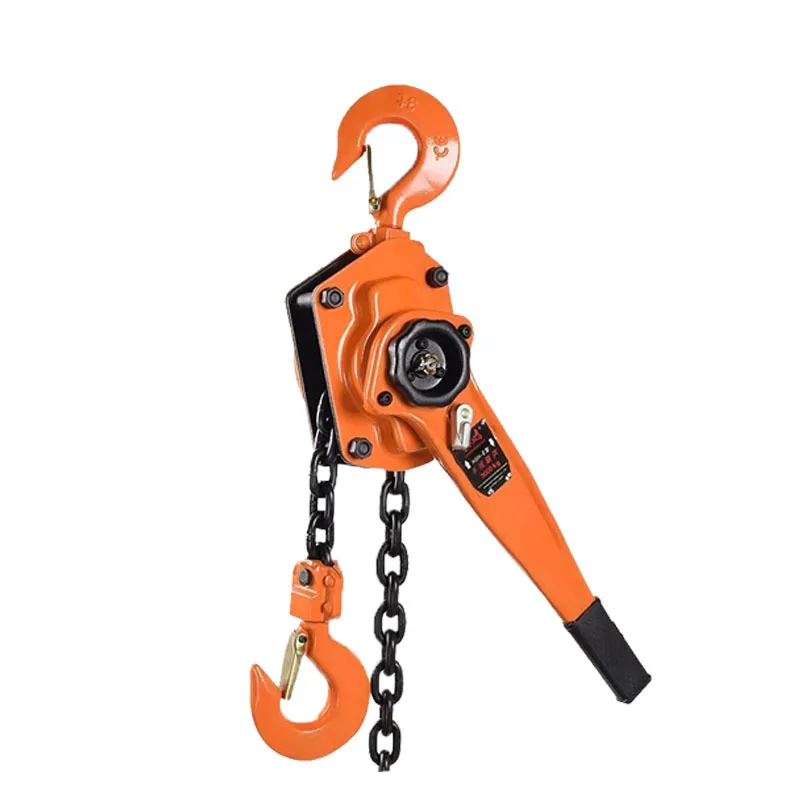
What it is (and why crews like it)
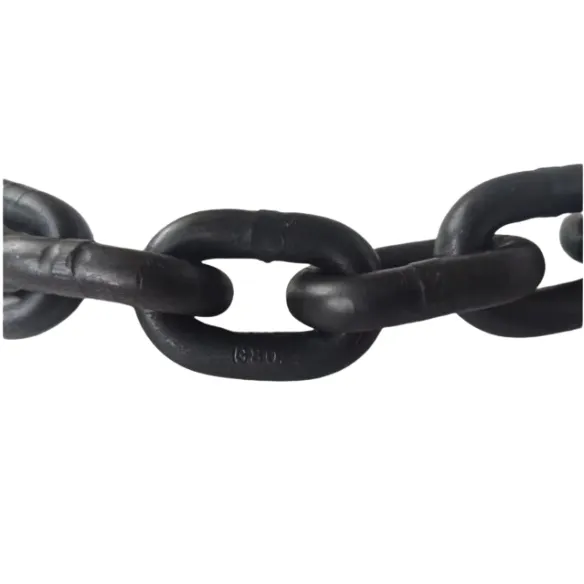
The Manual Lever Hoist—sometimes called a ratchet puller or hand chain block—uses a lever-and-ratchet drive to pull a grade alloy load chain. You get straight-line traction for lifting, lowering, inching, and even side-pulling within limits. Many customers say they prefer it over a hand chain hoist when they need fine control or non-linear traction. Origin: China; the unit here is the Bilopowtel model, which has the usual forged hooks, mechanical brake, and a decent paint job that actually holds up in the yard.
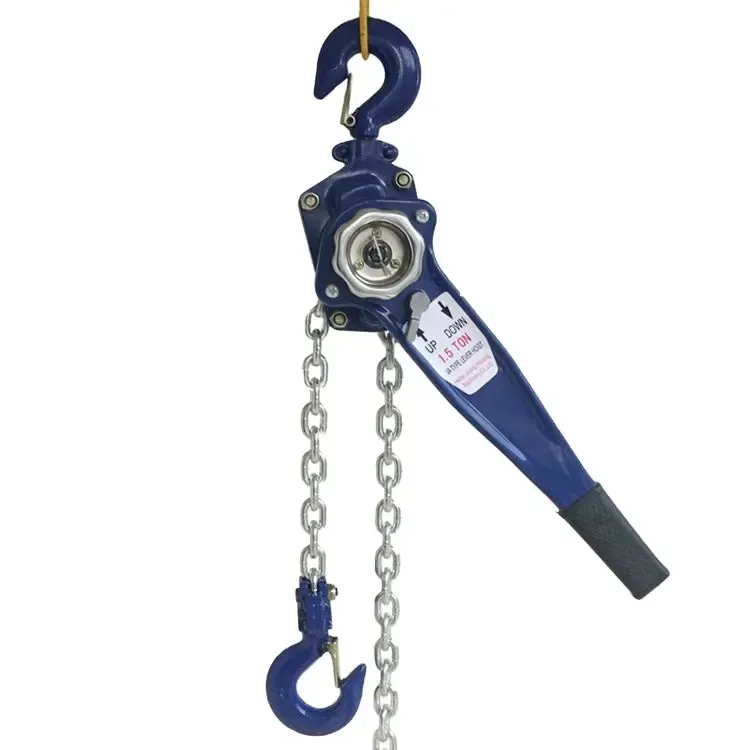
Industry trend check
- More Grade 100 load chain (and even specialty coatings) for better fatigue life.
- Factory overload limiters becoming standard above 1.5 t—good for training-heavy jobsites.
- Smoother pawl/brake geometry reducing handle effort at WLL by ~10–15% in real-world use.
- Documentation drift to EN 13157 and ASME B30.21 alignment, which buyers do read now, surprisingly.
How it’s built (short version)
Materials: alloy steel frame and gears; quenched/tempered, shot-peened Grade 80 or 100 load chain; die-forged hooks with safety latches. Methods include precision gear hobbing, induction-hardened pawl/ratchet, zinc-plated or black-oxide chain, powder-coated housings. Testing: proof load ≈ 150% of WLL, brake hold ≥ 125% WLL without slip, fatigue cycling to 1500–2500 cycles by model, and salt-spray (ASTM B117) 48–72 h on exposed parts. Service life? Around 5–10 years with proper inspection and moderate duty.
Typical applications
- Construction: setting embeds, steel fit-up, and panel alignment.
- Utilities: pole work, transformer positioning, and tensioning.
- Marine/shipyards: confined-space lifts, chain stops, and drivetrain alignment.
- Mining and rail: track alignment, conveyor maintenance, pull-tests.
Product specs (popular capacities)
| Model | WLL | Std. Lift | Load Chain | Effort at WLL ≈ | Net Weight ≈ |
|---|---|---|---|---|---|
| 0.75 t | 750 kg | 1.5 m | Ø6 mm, G80/100 | 230–260 N | 6.5 kg |
| 1.5 t | 1500 kg | 1.5 m | Ø8 mm, G80/100 | 280–320 N | 10.5 kg |
| 3 t | 3000 kg | 1.5 m | Ø10 mm, G80/100 | 340–390 N | 21 kg |
| 6 t | 6000 kg | 1.5 m | Ø10×2 fall | 380–420 N | 34 kg |
Note: proof load 1.5× WLL; dimensions/effort vary by configuration; real-world use may vary.
Compliance, tests, and paperwork
Conforms to EN 13157 for hand-powered lifting devices and ASME B30.21 in scope. Load chain is built to EN 818-7 (short-link hoist chain). Factory options include CE declarations per 2006/42/EC and RoHS for surface finishes. Each Lever Hoist ships with a test certificate showing proof-load, brake hold, and serial traceability. To be honest, I skim them—until the day I need them.
Vendor snapshot (what buyers compare)
| Vendor | Origin | Chain Grade | Overload Limiter | Lead Time ≈ | Certs |
|---|---|---|---|---|---|
| Bilopowtel Manual Lever Hoist | China | G80 / G100 | Optional ≥1.5 t | 2–4 weeks | EN 13157, CE |
| Brand H (JP) | Japan | G100 | Standard | Stock–2 weeks | ASME, CE |
| Brand E (EU) | EU | G80 | Optional | 3–6 weeks | EN 13157 |
Customization and add-ons
- Lift height from 1.5 m to 12 m; shipyard or swivel hooks; ship-ready paint.
- Overload limiter, stainless or spark-reduced kits (consult for hazardous zones).
- Chain grade, finish, and low-temp grease for −20 °C work.
Real-world snapshots
Wind farm service crew: two 1.5 t units used for yaw-drive swap. Proof load certs cleared site QA; average handle effort at WLL measured ~300 N, slightly below spec—operators noticed.
Shipyard alignment: a 3 t Lever Hoist plus a snatch block achieved a multi-angle pull to drift a gear casing 12 mm—no slip on the brake during micro-lowering, which is what the supervisor cared about.
Safety quick notes
- Never exceed WLL; observe derating for angles and side loading.
- Inspect chain for elongation/corrosion; retire if wear > 10% or per standard limits.
- Keep the latch functional; it’s not cosmetic—seen too many removed “for convenience.”
References (authoritative):
- ASME B30.21 – Safety Standard for Lever Hoists, The American Society of Mechanical Engineers.
- ASME HST-3 – Performance Standard for Chain Hoists, ASME.
- EN 13157:2004+A1:2009 – Hand-powered lifting equipment, CEN.
- EN 818-7 – Short link chain for chain hoists, CEN.
- Directive 2006/42/EC – Machinery Directive, European Commission.
Latest news
Precision Lifting and Pulling with the Lever Block 0.5 Ton Guide
NewsApr.16,2026
Precision Engineering Guide for High Performance Jet Lever
NewsApr.16,2026
Ultimate Guide to Choosing the Professional Industrial hoist lever
NewsApr.16,2026
Industrial Hoist Lever Chain Guide for Heavy Lifting and Rigging
NewsApr.16,2026
Industrial Lever Hoist Guide for Efficient Lifting and Pulling
NewsApr.16,2026
Ultimate Guide to Hand Ratchet Lift for Heavy Industrial Lifting
NewsApr.16,2026
- CONTACT
- ADDRESS: 188, Fengshou Road, Shijiazhuang. China
- EMAlL: info@bilopowtel.com
- PHONE: 0086-311-88862036
- WHATSAPP: 0086-152-26563165


